

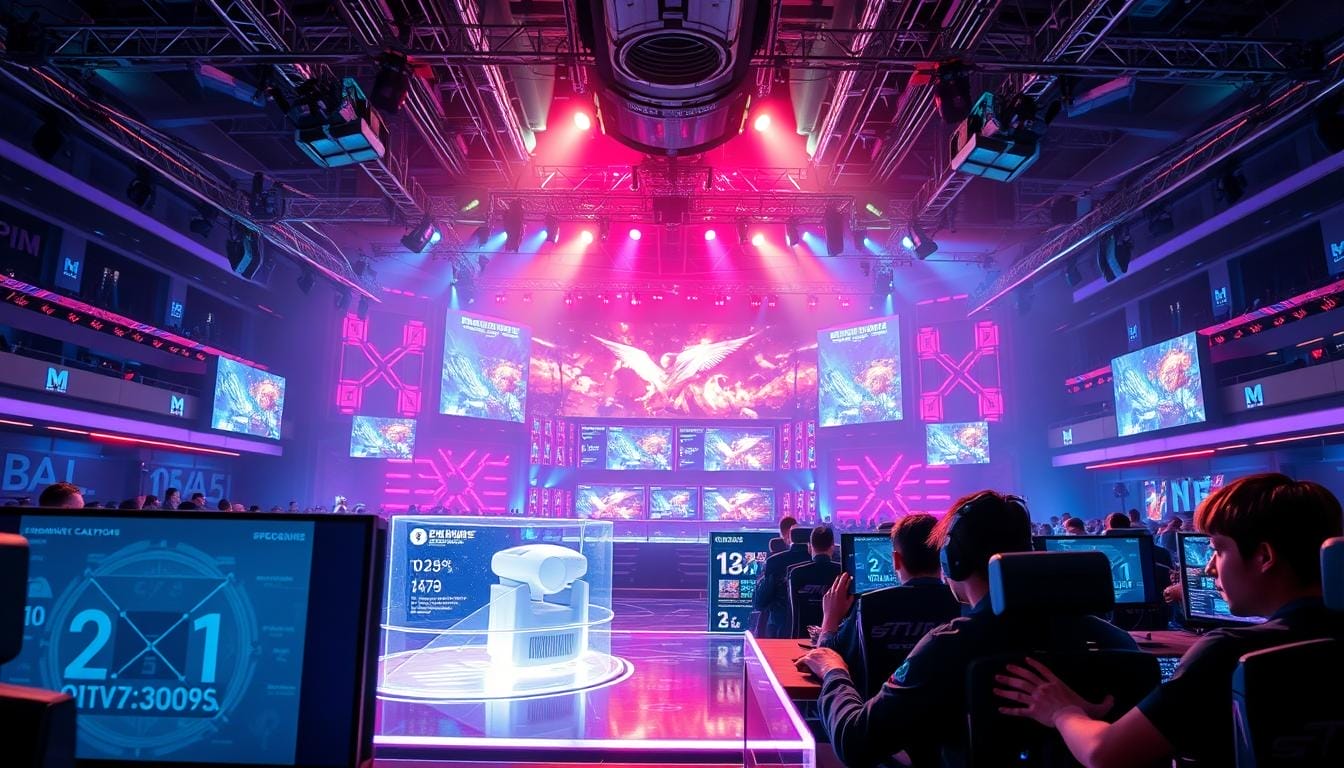
Surprising fact: professional events now analyze millions of match data points to shape plays and broadcasts — and that data changes how I train, stream, and win.
I dive into how modern ai-driven systems unite training, strategy, anti-cheat, and fan engagement into one connected experience. I test tools like Aim Lab and KovaaK’s for aim work, and I watch strategy suites such as Mobalytics to sharpen game sense.
I’ll explain how integrity tech like VACnet and Tencent ACE protects competition while smart cameras and Highlight.AI capture clutch moments for my viewers. GRID Insights and similar services turn raw telemetry into real-time insights I can use in scrims and VOD reviews.

Follow my grind on Twitch, YouTube, and socials to see these tools in action and ask questions live as I experiment with training, overlays, and analytics.
For more context on how AI reshapes competitive gaming, check this overview on AI in esports and my hands-on breakdown at my guide.
Key Takeaways
- AI combines training, strategy, and broadcasting to boost both performance and viewer experience.
- Tools like Aim Lab, KovaaK’s, Mobalytics, and GRID Insights provide practical, testable advantages.
- Anti-cheat systems such as VACnet and Tencent ACE keep competition fair and credible.
- Telemetry and APIs convert match signals into actionable insights for players and creators.
- Watching tech in action helps fans learn and creators find new content and sponsorship angles.
Esports at the present inflection point: how AI is reshaping competitive gaming
We’re at a tipping point where live match data reshapes decisions in seconds. The digital nature of modern matches gives me access to vast amounts of telemetry that traditional sports rarely capture.

From LAN rooms to stadiums, servers stream player movement, ability timing, and map control at frame-level precision. Those signals feed APIs and machine models that power live dashboards and predictive cues during play.
From LAN rooms to stadiums: why vast amounts of data give an AI edge over traditional sports
The real advantage is scale. Esports produces continuous, precise information that teams and coaches can parse instantly.
“Live telemetry turns raw events into strategy — not after the match, but while it’s happening.”
What’s changed now: real-time telemetry, APIs, and machine intelligence across games and teams
Teams build data pipelines that convert signals—cooldowns, rotations, economy states—into probabilities and counter suggestions.
- This reduces guesswork and tightens timing windows under pressure.
- It lets me anticipate opponent tendencies and adapt mid-match.
- Responsible use means protecting player info and following competition rules.
| Capability | Esports Advantage | Traditional Sports Contrast |
|---|---|---|
| Telemetry granularity | Frame-level events, ability timing | Mostly video and sensor summaries |
| Real-time modeling | Live predictive analytics and dashboards | Post-game analysis dominates |
| Operational use | Coaches receive scenario probabilities mid-match | Coaching relies on halftime or post-game adjustments |
| Impact on performance | Sharper strategies tuned to exact game state | Strategies guided by broader heuristics |
ai-driven esports platforms: where intelligence meets player performance

Smart coaching tools translate raw match snapshots into drills I can run tonight. I use adaptive systems to turn a VOD clip or screenshot into focused work on aim, timing, or rotation choices.
Intelligent coaching and adaptive training: Aim Lab, KovaaK’s, and Project AVA’s real-time guidance
Aim Lab and KovaaK’s give me targeted scenarios that shift as I improve. I build short training blocks for accuracy, tracking, and reaction. Those sessions evolve with my fatigue and schedule.
Razer’s Project AVA feeds live suggestions—dodge timing, enemy prediction, and positioning cues—so micro decisions and macro calls improve while I play.
Strategy optimization at scale: identifying patterns, counters, and meta shifts faster than humans
Tools like Mobalytics and Shadow.GG analyze frame-by-frame decision-making. They spot recurring mistakes, draft edges, and rotation gaps I can fix before a tournament.
Team pipelines and tools: integrating analytics engines into practice, scrims, and reviews
I map capture → storage → model → dashboard so coaches push tailored drills and scenario scrims directly to players. After-action reviews feed new data and re-tune those learning loops.
“The best gains come from short, repeatable drills coupled with rigorous review.”
- I use adaptive training to keep practice efficient and measurable.
- Real-time coaching turns insight into instant changes in play.
- Analytics let a team scale strategy work across scrims and VODs.
| Function | Tool / System | Benefit |
|---|---|---|
| Aim & mechanics | Aim Lab, KovaaK’s | Targeted drills that adapt to skill curve and time |
| Real-time coaching | Project AVA | Live micro/macro suggestions from coach knowledge |
| Strategy analysis | Mobalytics, Shadow.GG | Frame-level patterns, counters, and meta signals |
| Team workflow | Custom pipelines | Capture to dashboard for tailored practice and reviews |
For a broader view of how these systems are changing competitive play, see my overview on AI in esports.
Player development and edge: machine learning for reaction time, decision-making, and team systems
Breaking play down to frames and milliseconds shows where real gains hide. Machine learning captures reaction times, crosshair placement, and positional choices so I can target the exact habits that lose rounds.
Micro-moments that decide matches: frame-by-frame insights, positioning, and timing
Models flag the micro-moments that flip rounds—pre-aim angles, shoulder peeks, and utility layering. I review tagged clips and note the timing windows I miss most often.
Heatmaps and pathing analysis show risky rotations and off-angle holds that correlate with round losses. That turns vague intuition into clear data I can fix.
Personalized regimens: targeted drills that evolve with player skill and cognitive load
Adaptive trainers like Aim Lab scale targets from static to dynamic as my accuracy improves. This keeps training challenging but not overwhelming.
- I build short, high-intensity sets for raw mechanics, then follow with scenario drills that match my role and map pool.
- Load management helps me add speed and precision without burning out.
- Team systems codify callouts, utility combos, and trade setups; AI review checks timing and spacing under pressure.
“I measure progress with player performance dashboards—first-shot accuracy, swing success, and clutch conversion.”
Closing the loop with VOD reviews and annotated moments makes next week’s learning plan precise and repeatable. These insights lift both my individual performance and how my team plays together.
Integrity first: AI anti-cheat systems, fair play, and match integrity in real time
I rely on real-time integrity checks to protect matches from subtle, automated cheating. Machine learning now spots patterns that humans often miss. These systems analyze precision, reaction times, and movement signatures to flag suspicious behavior.
Behavioral anomaly detection models learn what legitimate play looks like and mark deviations like hyper-precise flicks or perfect wall pre-aims. Valve’s VACnet, for example, reviews CS:GO clips to learn “unnatural” aiming at scale.
Tencent’s ACE team complements signature scans with behavioral analysis. Their tools surface macros and hardware exploits that slip past traditional detection.

“Layered, explainable analysis helps tournaments act faster while minimizing false positives.”
- Real-time systems protect match integrity during qualifiers and tournaments with live monitoring and quick review.
- Best practices: pre-event client checks, live audits, and transparent appeal processes keep competition fair and trusted.
- Continuous retraining and shared data across leagues strengthen defenses and yield better solutions over time.
| System | Primary Use | Benefit |
|---|---|---|
| VACnet | Clip-level behavioral analysis | Faster, evidence-backed flags for aim anomalies |
| Tencent ACE | Behavioral signals and hardware exploit detection | Finds subtle macros and non-signature cheats |
| Real-time monitoring stacks | Live checks during events | Preserves integrity and reduces downtime for tournaments |
Broadcasting, highlights, and fan experience: algorithms that capture the moments that matter
Smart tools help me capture the story of a match by surfacing clutch plays the moment they happen. Automated systems sift through kills, objectives, and big plays so viewers see the highlights without delay.
Automated highlights and smart cameras
Highlight.AI can auto-build reels from key events like ace rounds and objective steals. That saves editors hours and gets clips to fans faster.
Smart camera logic in games such as Dota 2 and StarCraft II predicts where fights will erupt, which reduces missed moments and keeps viewing smooth.
Personalized viewing and curated streams
I can follow a single player, a role, or a map zone with overlays tuned to the stats I care about most. Personalized views increase engagement by matching content to individual interests.
Virtual analysts and live overlays
GRID Insights adds on-air predictive win rates and context. Seeing shifting probabilities helps fans understand momentum swings as fights and objectives unfold.
“Good analytics turn raw data into clear stories so new viewers learn why a moment mattered.”
- Smart packaging—replays, chaptered highlights, and timelines—lets fans jump to big moments quickly.
- Accessibility matters: clean graphics, color-safe overlays, and short explanations welcome new viewers without dumbing down analysis.
- Unifying live, VOD, and social clips meets fans wherever they watch and boosts long-term engagement.
For teams and content creators exploring how these systems fit into operations, see my notes on AI platforms for professional teams for a practical breakdown of tools and workflows.
Predictive analytics, betting markets, and monetization: turning data into decisive insights
I use historical match records to build live projections that inform tactical calls under pressure. These live probabilities guide timeouts, risk-taking, and draft choices for teams and casters.
From historical data to live probabilities
Simple logistic regression feeds features like gold differential, kill advantage, and map control into win-rate curves. Early-game models in League reach about 0.72 accuracy within ten minutes.
Relational signals and lethal-event prediction
Graph Convolutional Networks capture how team relations and rotations influence outcomes. Survival analysis and RNNs estimate when momentum flips or kill chains begin.
Market dynamics and continuous retraining
Commercial services like GRID Insights and Stats Edge deliver live overlays and team dashboards. Value bettors find opportunities when model projections diverge from automated odds, forcing frequent retraining after patches.
“Continuous backtests and careful class balancing keep models useful across patches.”
| Model | Primary Signal | Typical Accuracy |
|---|---|---|
| Logistic Regression | Gold, kills, map control | ~0.72 early-game (LoL) |
| GCN | Team relations, rotations | Captures relational patterns |
| Neural Net | Lethal-event windows (Dota 2) | Recall ~0.725 (5s window) |
Challenges, governance, and the road ahead for AI in esports
Every new tool brings choices about who controls player data and how decisions get made. I see real upside in artificial intelligence, but benefits come with clear risks to privacy, fairness, and storytelling.
Ethical use, bias, and privacy should be the first design criteria for any system I add to my workflow.
I require consent, strict retention rules, and anonymization so player and viewer information stays protected. Fairness needs diverse training sets and human review when sensitive calls—like anti-cheat alerts or roster suggestions—are made.
Rapid meta changes and model drift
Patches alter game balance fast, so models can drift in days. I schedule frequent validation and retraining to keep predictions useful.
Performance dashboards that track accuracy, latency, and calibration tell me when to trust outputs and when to fallback to human judgment.
Human-AI collaboration
Coaches still set intent; systems surface probabilities and options. Together we align calls on draft, timing, and map picks with team identity.
“Good governance blends transparent audit trails, escalation paths, and an explicit retrain cadence.”
- I document data sources and roles, and I simulate failures before tournament time.
- I push for transparency reports and audit logs so leagues can verify compliance.
- For teams exploring operational playbooks, see my notes on AI solutions for teams.
Conclusion
Conclusion
Across broadcasts and scrims, systems that surface the right insights at the right time change how we play and view games.
I believe artificial intelligence, machine tools, and machine learning now sit at the core of competitive sports and online competition. Data from GRID Insights, Aim Lab, KovaaK’s, Project AVA, VACnet, and Tencent ACE powers sharper training, cleaner integrity checks, and smarter broadcast cues.
That mix gives teams and players a measurable edge while improving the viewing experience for fans. Success favors groups that operationalize systems, retrain models, and protect privacy so tournaments stay fair.
Let’s keep the grind going—join me live: Twitch: twitch.tv/phatryda • YouTube: Phatryda Gaming • Tip: streamelements.com/phatryda/tip. Thanks to the community that pushes this work forward.
FAQ
What exactly are AI-driven competitive gaming platforms and how do they differ from traditional tools?
I define these systems as software that combines machine learning, telemetry feeds, and analytics to improve player and team performance in real time. Unlike traditional replay tools or manual scouting, these solutions ingest large-scale match data, run pattern detection, and surface actionable insights—from micro-positioning tips to strategy shifts—so coaches and players can adapt faster during practice and events.
How does real-time telemetry give competitive gaming an advantage over traditional sports analytics?
I see real-time telemetry as game-changing because it delivers frame-by-frame state information—player positions, ability cooldowns, economy, and more—at millisecond resolution. That granularity lets machine intelligence detect nuances and trends that are impossible in many traditional sports, enabling automated scouting, precise training drills, and instant broadcast overlays.
Are specific training tools worth using for aim and reaction development?
Yes. I recommend evidence-backed tools like Aim Lab and KovaaK’s for mechanical practice; they provide objective metrics and adaptive drills. Emerging systems that blend these drills with match telemetry can speed progress by tailoring regimens to a player’s fatigue, reaction profiles, and common in-game mistakes.
How do analytics engines help teams optimize strategy and respond to meta shifts?
I rely on analytics to identify recurring patterns, successful counters, and timing windows for decisive plays. Graph-based models and sequence mining reveal meta dynamics earlier than human observation alone, so teams can test new tactics in scrims and update playbooks before major tournaments.
Can machine learning actually improve decision-making and cognitive skills for players?
It can. I use supervised and reinforcement learning signals to isolate decision points—when to rotate, when to trade, when to hold angles—and convert them into targeted drills. Over time, players internalize faster, more situationally aware choices because training adapts to their evolving strengths and cognitive load.
How do anti-cheat systems use AI to protect match integrity?
I employ behavioral anomaly detection and pattern analysis to spot deviations from human play—irregular aim traces, impossible movement, or statistically improbable sequences. These models run alongside traditional signature-based systems to catch subtle cheats in real time while minimizing false positives through continual retraining and human review.
What role do automated highlights and smart cameras play in the fan experience?
Automated systems analyze event importance—multi-kills, objective captures, clutch situations—and cut highlights or reframe camera angles accordingly. I find this increases engagement by delivering compact, narrative-driven moments and by enabling personalized streams focused on specific players, roles, or map areas.
How reliable are predictive models used for live probabilities and betting markets?
Predictive accuracy depends on model design and data freshness. I combine logistic models, temporal networks, and survival analysis to estimate win probabilities, but I always account for model drift after patches or roster changes. Continuous retraining with live telemetry and proper uncertainty calibration keeps predictions meaningful for both analysts and market operators.
What data points matter most for game-state prediction in titles like Valorant or League of Legends?
I prioritize economy state, ultimate availability, K/D spread, position control, and lethal-event indicators. These signals, when modeled together, capture momentum and claim windows where the probability of decisive engagements spikes, enabling reliable short-term forecasting.
How do teams integrate analytics into practice, scrims, and reviews without disrupting workflow?
I recommend phased integration: start with automated post-scrim reports that highlight key metrics, then introduce live overlays during closed practice, and finally embed analytics into review sessions where coaches translate data into concrete drills. Low-latency APIs and clear visualizations help adoption and reduce disruption.
What governance and ethical challenges should organizations consider when using machine intelligence?
I insist on transparency, data privacy, and bias auditing. Teams must get informed consent for biometric or sensitive telemetry, deploy explainable models to avoid opaque decisions, and monitor for systemic bias—especially in scouting or automated evaluations that affect contracts and careers.
How do systems handle rapid patch changes and model drift?
I handle drift by maintaining continuous evaluation pipelines, retraining on recent match data, and flagging performance drops after patches. Short retraining cycles, ensemble methods, and human-in-the-loop validation keep models aligned with the evolving game state.
What are realistic short-term ROI opportunities for organizations investing in these systems?
I see clear returns in improved practice efficiency, reduced scouting time, stronger broadcast engagement through personalized viewing, and better competitive outcomes. Smaller teams can gain disproportionate value by using analytics to optimize scrim targets and player development at lower cost than hiring top-tier coaching staff.
How can fans get more personalized viewing experiences using these technologies?
I suggest fans use curated streams and companion apps that filter content by player, role, or map control. Machine-driven overlays and automated highlights let viewers follow specific narratives—like economy battles or clutch probability—so each fan can craft a viewing experience that matches their interests.
What skills should analysts and coaches develop to work effectively with machine learning systems?
I advise analysts to gain fluency in data interpretation, feature selection, and basic model behavior, while coaches should learn how to translate metrics into actionable drills. Cross-disciplinary knowledge—game theory, statistics, and systems thinking—helps teams extract practical value from analytics tools.
Are there privacy risks for players when telemetry and biometric data are collected?
Yes. I always recommend strict data governance: limit collection to what’s necessary, anonymize where possible, secure storage, and obtain informed consent. Clear retention policies and access controls protect players and help organizations comply with regulations like GDPR when applicable.
What does the future look like for human-AI collaboration in competitive gaming?
I expect tighter partnerships where AI handles pattern detection and repetitive optimization, while humans focus on creativity, leadership, and split-second judgment. This collaboration will raise the level of play, create richer broadcasts, and broaden career paths for analysts, engineers, and performance coaches.
