

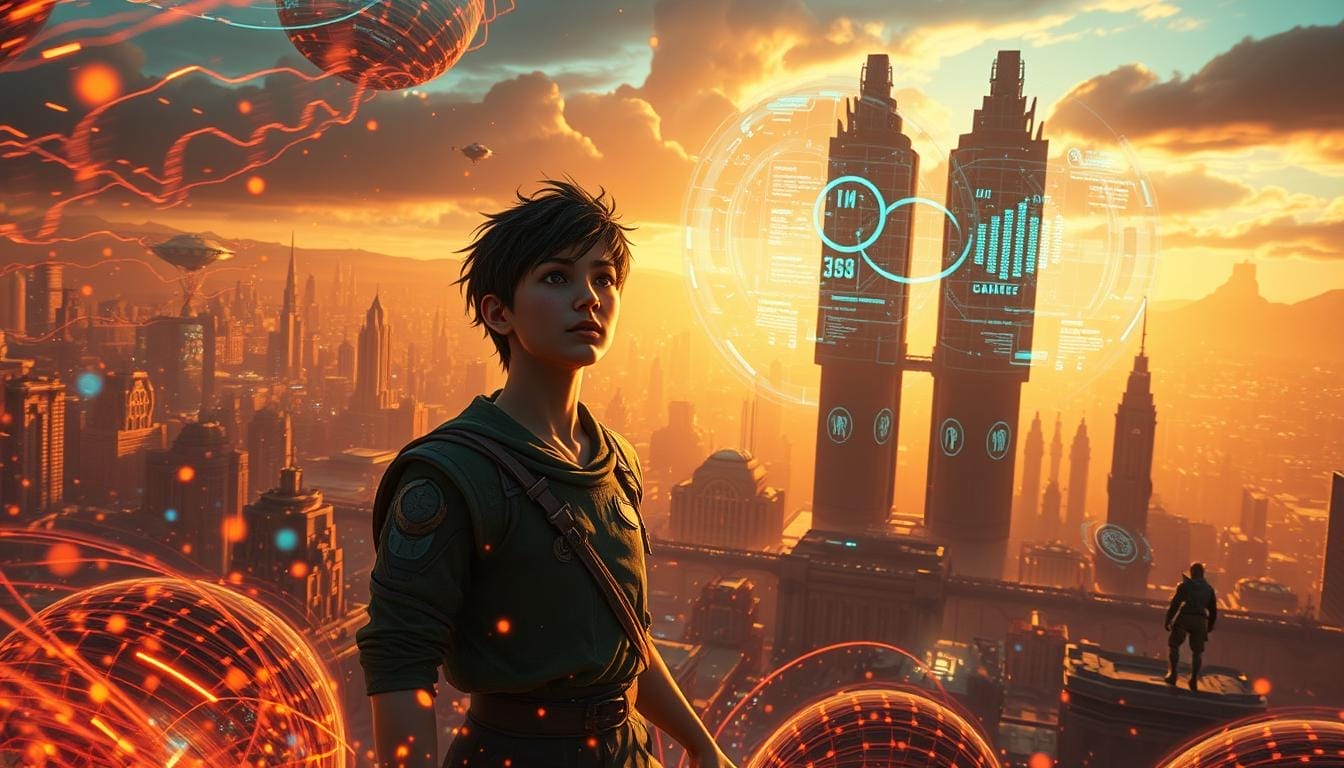
Did you know that 72% of players say dynamic narratives keep them playing longer? That fact changed how I design worlds.
I opened up about how ai-driven game storytelling shaped my creative direction. I blend tech with imagination to craft an experience that responds every time you press start.
My aim is simple. Use systems that act like a creative partner so each session feels fresh, not recycled. I test ideas live on Twitch and YouTube, iterate in public, and tune what resonates before I lock it into a larger vision.

This matters for my community because spontaneity pulls players into the moment, much like a tabletop session. Follow me: twitch.tv/phatryda | YouTube: Phatryda Gaming | TikTok: @xxphatrydaxx.
Key Takeaways
- I use AI as a creative partner to keep play sessions dynamic and engaging.
- Live streaming helps me prototype, get feedback, and refine ideas fast.
- Responsive narratives bring the spontaneity of tabletop play to digital worlds.
- My approach balances technical depth with accessibility for all players.
- Follow my channels to see prototypes, playtests, and post-launch tuning.
Why AI matters to my game design mindset and streaming community
Watching live reactions rewired how I think about design and player moments. I learned fast which systems spark interest and which fall flat when I stream. Short tests and chat feedback give clear, honest signals.
AI helps me analyze player choices without losing the human story. It surfaces patterns in clips and chat so I can spot trends in player behavior. That lets me tweak systems to improve interactions and pacing.

I focus on systems that elevate player agency. Small changes can turn a forgettable run into a memorable experience. My community helps set the roadmap by voting, testing builds, and posting VOD comments.
- Faster prototyping with AI tools keeps player feedback central.
- I balance metrics with empathy to protect trust.
- Community co-creation shapes future game development sprints.
| Focus | Benefit | Outcome |
|---|---|---|
| Live streaming | Real-time reactions | Better design choices |
| AI analysis | Pattern detection | Faster iteration |
| Community input | Actionable feedback | Player-centered features |
Connect: 🎮 twitch.tv/phatryda | YouTube: Phatryda Gaming | Xbox: Xx Phatryda xX | PlayStation: phatryda | TikTok: @xxphatrydaxx | Facebook: Phatryda | Tip: streamelements.com/phatryda/tip | TrueAchievements: Xx Phatryda xX.
From Pong to procedural worlds: a brief history that shaped my approach
Tracing arcade code taught me that elegant rules often make the deepest play experiences.

Pong used a single reactive rule: track the ball and move the paddle. That tiny behavior created tense, readable matches in little time.
Pac‑Man showed me how four distinct ghost behaviors could feel like personalities. Blinky, Pinky, Inky, and Clyde used simple decision rules to pursue or evade, proving behavior variety scales player engagement.
Pushing algorithms and thinking forward
Deep Blue in 1997 used search and evaluation algorithms to beat Kasparov. That moment reframed how I see computation: heuristics and search can outpace intuition over time.
- I learned that finite‑state machines and behavior trees make NPCs readable and fair.
- I saw how search strategies inspired adaptable systems without brute force.
- I began balancing handcrafted rules with data and later machine learning for richer worlds.
| Era | Key tech | Design lesson |
|---|---|---|
| 1970s–80s | Reactive AI, finite rules | Simplicity yields clarity and fun |
| 1990s | Search & evaluation algorithms | Computation + heuristics scale skill |
| 2000s–now | Behavior trees, data-driven, ML | Choose tools to fit the problem |
For deeper reading on how these methods power modern systems, see my writeup on interactive game environments.
ai-driven game storytelling
I designed narratives that update in real time to reflect the player’s tactics, tone, and long-term moves.
Dynamic narratives vs. fixed dialogue trees: what changes for players
Fixed dialogue funnels limited outcomes through rigid branches. Dynamic systems react to intent and context instead.
That shift makes interactions feel personal. Players no longer pick a scripted line; the world replies to their pattern of choices.
Real-time adaptation: weaving player actions, choices, and consequences
When narratives update in real time, consequences land harder. A single tactic can alter NPC behavior, pacing, and later encounters.
I design signals so players read why the world changed. Readability keeps emergent arcs from feeling random.
Data-informed stories: how developers analyze player behavior to tune experience
I use data to analyze player patterns ethically. That helps me tune difficulty, encounter density, and character arcs without flattening emotion.
For deeper methods and examples, see my writeup on narrative generation.
- Adaptive dialogue keeps conversations fresh and context-aware.
- An npc that remembers tactics raises stakes across the world.
- Balancing authored beats with flexible systems preserves a coherent spine while honoring freedom.
Smarter NPC behavior and adaptive gameplay in today’s titles
I learned early that believable NPC behavior makes virtual worlds feel honest. Small routines and clear reactions let players read the scene and plan around it.
The Elder Scrolls V: Skyrim used Radiant AI to give npcs daily schedules and reactive states. That made the world feel persistent even when I was offline.
Alien: Isolation taught me how a director system paired with a behavior tree creates dread. The director varies pace while the Xenomorph’s behavior keeps proximity and timing unpredictable.
The Last of Us showed how companions can support play without stealing focus. Contextual animations and dialogue make characters feel present and useful in tense scenes.
“Fair surprise — signals players can read — keeps tension meaningful while protecting playability.”
- I unpacked how small cues — glances, stance shifts, short barks — change encounters into memorable experiences.
- I prototype adaptive triggers that nudge difficulty without breaking immersion.
- I test loops to tune stealth cues and aggression spikes so players feel challenged, not cheated.
For a deeper look at how I apply these lessons to systems and streaming, see my writeup on ai in game design and development.
Machine learning in games: models that learn, adapt, and scale
Machine learning changed how I tune opponents to feel both clever and fair.
Reinforcement learning taught agents to improve via trial and reward. In practice this means opponents adapt tactics in real time instead of following fixed scripts.
Reinforcement learning in Age of Empires IV
During AoE IV development, reinforcement techniques pushed AIs to shift strategies mid-match. The result was more assertive build orders and tactical pivots that force the player to rethink decisions on the fly.
RLGym and Rocket League at 800x
RLGym speeds training so bots learn at roughly 800x. Self-play and high-speed loops let models explore rare scenarios far faster than human testing. That scale produced emergent playstyles that felt fresh and competitive.
Racing lines that fight back: MotoGP
MotoGP uses models that adapt braking and lines based on pressure. AI drivers respond to a player’s choices, which keeps races dynamic and readable.
- I instrument data to track learning progress and spot degenerate tactics.
- I pick algorithms to balance generalization vs. overfitting within game development timelines.
- Developer guardrails keep evolution transparent so players understand why opponents get smarter.
Procedural content generation to living worlds
I use procedural systems to scale handcrafted moments into roaming, replayable spaces. This lets me blend authored beats with algorithmic variation so the world feels intentional and fresh.

AI-driven procedural content for levels, encounters, and assets
Procedural content generation seeds layouts with rules and palettes I set. I define encounter templates, pacing, and asset tags so automatic runs respect tone and difficulty.
These methods speed content generation while keeping coherence. I run telemetry and playtests to prune patterns that break flow or overwhelm players.
Balancing authored intent with algorithmic generation
I lock key handcrafted set pieces and let algorithms fill connective tissue. That mix preserves moments I care about and allows endless variations between them.
- I seed procedural content with authored constraints and style guides.
- I use tools to define encounter palettes and pacing templates.
- ai-driven procedural content increases asset variety while tagging keeps cohesion.
| Area | Rule | Benefit |
|---|---|---|
| Level layout | Pacing templates + seeded hubs | Readable exploration |
| Encounters | Palette rules + difficulty curves | Balanced challenge |
| Assets | Tagging & style guide | Visual consistency |
Inside AI Dungeon: lessons from a generative, player-led narrative
I dug into AI Dungeon to see how free-form prompts reshape player agency and surprise. Nick Walton and Latitude tuned large language models to favor creativity over literal correctness, and that choice changed how players interact with narratives.
LLMs for creativity over correctness
That emphasis lets players type anything and watch the world respond. The result is playful, often messy, and full of emergent moments that feel truly personal.
Memory systems and creative seeding
The team built memory to track relationships, facts, and world state so characters remember you across sessions. Creative seeding adds variety so characters and places avoid repeating the same tropes.
Toward a “generative Skyrim”
I imagine persistent maps, NPCs that keep schedules, and multiplayer spaces where choices ripple across players. Visuals and maps would lock key beats while generators fill connective detail.
Consequences by design
AI Dungeon discouraged save-scumming to make loss matter. That design fosters tension and gives choices real weight, which I now borrow when I balance authored beats with open-ended systems.
- I saw how player input can teach systems while respecting safety.
- Memory + seeding keeps characters feeling like partners, not props.
- Designing for consequence deepens immersion and long-term attachment to worlds.
| Feature | Benefit | Design way |
|---|---|---|
| LLMs tuned for creativity | Unexpected, vivid narratives | Accept variance, guide tone |
| Memory systems | Continuity across sessions | Track relationships & states |
| No save-scumming | Meaningful loss | Enforce consequences |
Ethics and the role of creators: augmentation, not replacement
I believe the right approach pairs human taste with automated assistance to unlock fresh design space. My stance is clear: technology should extend creative reach, not displace the people who make play meaningful.
AI Dungeon’s team hired designers and worldbuilders to tune models rather than replace authors. That pattern guides how I vet tools and shape policies in my studio.
Using AI to invent new genres without displacing artists
I evaluate every tool through an ethical lens. I ask whether it respects contributors, data consent, and attribution before I add it to a pipeline.
- Developers should publish clear data policies so communities know what was used and why.
- I set review gates that ensure AI features amplify artistic intent during testing and playtests.
- Community feedback loops act as a guardrail, keeping gaming culture part of design decisions.
In practice, the future belongs to teams that blend human design instincts with selective automation. If you want a deeper technical angle on integration, see my piece on AI integration with engines.
“New forms of play should raise creative opportunity, not cut the people who create it.”
Where to connect with me and see this in action
Join my streams to watch systems get hammered out, tuned, and sometimes broken — all in front of an audience.
I invite you to jump into live sessions where I test narrative prototypes and explain design decisions as they unfold.
Watch and chat live: twitch.tv/phatryda
Live chat shapes what I change next. Your feedback helps tune balance and pace.
Long-form breakdowns and VODs: YouTube — Phatryda Gaming
I post deep dives and post-stream VODs that show how systems behaved with players today.
Join my sessions: Xbox — Xx Phatryda xX | PlayStation — phatryda
Drop in to stress-test builds and give hands-on feedback while I record metrics and reactions.
Short-form highlights: TikTok — @xxphatrydaxx
Community hub: Facebook — Phatryda
Support the grind: streamelements.com/phatryda/tip
Track my achievements: TrueAchievements — Xx Phatryda xX
| Platform | What you get | Best for |
|---|---|---|
| Twitch | Live tests, real-time chat | Immediate feedback |
| YouTube | Deep breakdowns, VODs | Study systems later |
| Xbox / PlayStation | Join sessions, play together | Hands-on testing |
| TikTok / Facebook | Quick highlights, polls | Short updates & community input |
Quick ask: DM or comment with ideas. Your input shapes the next updates and the experiences we build together. Thanks for being part of this and for supporting the grind — see you on stream.
Conclusion
What matters most is how moments add up: a single choice can echo across characters, dialogue, and worlds over time.
I wrapped the journey from classic heuristics to modern systems that lift storytelling and interactions in the moment. Persistent characters and npcs now remember, react, and evolve so each experience feels earned.
When procedural content generation follows authorial intent, content generation expands replayability without diluting craft. Developers can pair principled tools with clear design goals to ship better game design faster while protecting player trust.
Looking to the future, authored arcs and ai-driven procedural content will coexist, keeping surprises coherent. Join me on stream and socials so we keep building these worlds together, with transparent, ethical development at the core.
FAQ
What do I mean by "AI-Driven Game Storytelling" and why should you care?
I use machine learning and procedural systems to shape narratives that respond to player actions in real time. That approach helps create more personal, replayable experiences where characters, worlds, and consequences adapt to how you play. It matters because it lets developers and streamers deliver experiences that feel alive rather than scripted.
How does this approach change my design mindset and benefit my streaming community?
I shift from writing fixed dialogue and rigid quest lines to designing systems and tools that generate moments based on player behavior. For my community, that means unique playthroughs, emergent interactions during streams, and moments that encourage viewer engagement and co-creation.
How did classic titles like Pong and Pac‑Man influence my thinking about NPC behavior?
Early titles taught me the power of simple rule sets and predictable decision rules. Those foundations show how basic behaviors combine to produce compelling emergent patterns—lessons I use when crafting modern adaptive agents and modular AI systems.
Which algorithms and milestones shaped modern in‑game AI thinking?
From Deep Blue’s search strategies to contemporary reinforcement learning and neural models, I draw on pathfinding, behavior trees, and learning algorithms. Together they inform how NPCs make decisions, adapt to players, and scale across complex worlds.
What’s the difference between dynamic narratives and fixed dialogue trees?
Fixed trees limit outcomes to pre authored branches. Dynamic narratives use data, models, and procedural rules to react to player choices, producing variations and unexpected consequences that keep players discovering new content.
How do systems adapt to player actions in real time?
I combine runtime telemetry, behavior models, and adaptive directors to adjust pacing, NPC goals, and encounter difficulty on the fly. That lets the experience shift organically to match player skill, style, and emergent choices.
How do developers use player data to tune narratives and systems?
I analyze play traces, decision points, and engagement signals to find pain points, favorite moments, and dead content. That feedback informs tuning—altering encounter frequency, dialogue seeds, and branching weights to improve flow and meaning.
What lessons do modern titles like Skyrim and Alien: Isolation offer about NPCs?
Skyrim’s Radiant AI shows how routines and world persistence create a living backdrop. Alien: Isolation demonstrates how combining a director system with behavior logic sustains tension and unpredictable encounters without feeling unfair.
How have companion characters evolved in narrative design?
Games like The Last of Us teach me to use contextual interactions and stateful relationships so companions react believably. That strengthens emotional stakes and lets companions feel like partners rather than scripted props.
Where does machine learning fit into adaptive gameplay?
I leverage reinforcement learning, imitation, and supervised models to create agents that learn strategies, adapt to novel tactics, and scale across scenarios. These models let NPCs adopt diverse playstyles and provide emergent challenge.
Can you give real examples of ML in production titles?
Titles such as Age of Empires IV explore RL to shift strategies, while research systems used in Rocket League (RLGym) show how accelerated training creates emergent play. Racing series like MotoGP experiment with adaptive drivers that respond to player lines.
How does procedural content generation fit into living worlds?
Procedural systems generate levels, encounters, and assets rapidly while designers guide intent. I balance authored beats with algorithmic variety to keep worlds coherent, replayable, and surprising.
How do I balance authored intent with algorithmic generation?
I set constraints, narrative anchors, and evaluation metrics so generated content respects story goals and design quality. That combination preserves authored meaning while unlocking scale and diversity.
What can we learn from generative platforms like AI Dungeon?
Generative platforms highlight creative potential and the need for memory systems, seeding, and guardrails. They show how models can amplify player creativity while exposing challenges around coherence and safety.
How do memory systems and creative seeding improve emergent narratives?
I persist character traits, player choices, and world changes so future interactions have continuity. Seeding with key motifs and constraints helps models produce coherent, relevant content across long sessions.
What does a “generative Skyrim” look like to me?
It’s a persistent world where maps, NPCs, and quests evolve from player decisions and procedural rules. Players experience lasting consequences, emergent factions, and multiplayer interactions that feel consequential rather than isolated.
How do I design consequences so players take them seriously?
I remove easy escape hatches, design irreversible outcomes where appropriate, and build systems that visibly reflect player impact. Meaningful loss and tradeoffs increase immersion and emotional investment.
What ethical considerations guide my work with machine models?
I emphasize augmentation over replacement—tools that empower writers and artists, not replace them. I also prioritize transparency, fairness, and safeguards to prevent harmful or biased outputs.
How can AI help invent new genres without displacing creators?
By automating repetitive tasks and generating prototypes, AI frees creators to explore bolder concepts. It becomes a collaborator that accelerates iteration, not a substitute for human vision and craft.
Where can people watch me demonstrate these systems live?
I stream on Twitch at twitch.tv/phatryda and post long-form breakdowns on YouTube under Phatryda Gaming. I also share highlights on TikTok (@xxphatrydaxx) and host community discussions on Facebook under Phatryda.
How can viewers join my sessions or support my work?
You can join multiplayer sessions via Xbox (Xx Phatryda xX) or PlayStation (phatryda). Support comes through Streamelements (streamelements.com/phatryda/tip) and you can track achievements at TrueAchievements under Xx Phatryda xX.
